
How Much Blood Is in the Human Body? Normal Blood Volume, RBC and WBC Counts
Have you ever wondered how much blood is in the human body or how many red and white blood cells are needed for normal health?
Blood is one of the body’s most important tissues. It transports oxygen and nutrients, carries hormones and waste products, helps regulate body temperature and supports the immune system.
The amount of blood and the number of blood cells are not exactly the same for everyone. They vary according to factors such as body size, age, sex and certain physiological conditions.
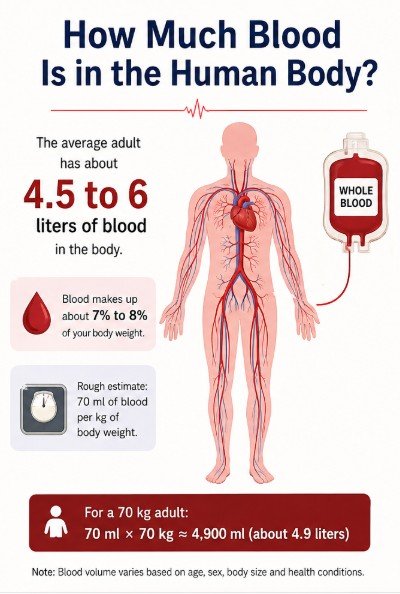
For most adults, total blood volume is roughly 4.5 to 6 liters, although individual values can be outside this range. A commonly used rough estimate is about 70 milliliters of blood per kilogram of body weight.
How Much Blood Is in the Human Body?
Most adults have approximately 4.5 to 6 liters of blood circulating through their body.
Blood volume depends largely on body size. A larger person generally has more circulating blood than a smaller person. Blood volume also changes during certain life stages and conditions, including pregnancy.
Another useful way to think about blood volume is as a percentage of body weight. Blood accounts for roughly 7% to 8% of adult body weight.
Example
For a 70 kg adult:
70 kg × 70 mL/kg ≈ 4,900 mL
That’s approximately 4.9 liters of blood.
This is only a rough estimate. Actual blood volume should not be calculated from this formula for medical decisions.
What Is Blood Made Of?
Blood isn’t simply a red liquid. It consists of plasma and blood cells.
The major components are:
Plasma
Red blood cells (RBCs)
White blood cells (WBCs)
Platelets
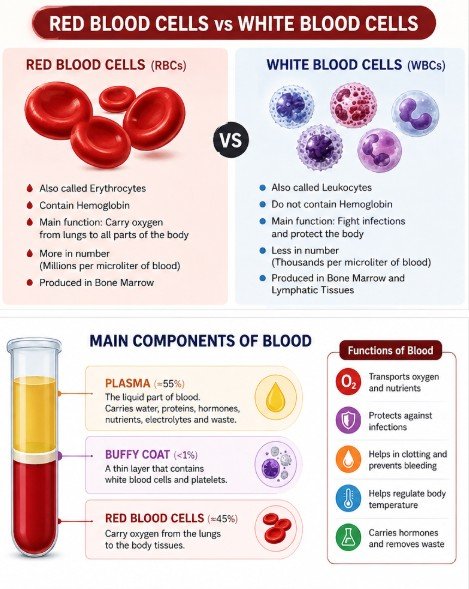
Whole blood is approximately 55% plasma, with the cellular components making up most of the remaining volume
Plasma
Plasma is the liquid portion of blood. It carries blood cells and transports proteins, nutrients, hormones, electrolytes and waste products throughout the body.
Red Blood Cells
Red blood cells, also called erythrocytes, contain hemoglobin and are responsible for transporting oxygen from the lungs to body tissues. They also help carry carbon dioxide back toward the lungs
White Blood Cells
White blood cells, or leukocytes, are an important part of the immune system. They help the body identify and respond to infections and other threats.
Platelets
Platelets are small cell fragments that help blood clot. They play an important role in stopping bleeding after an injury.
How Many Red Blood Cells Are Normal?
The red blood cell count is usually measured as the number of RBCs in a microliter of blood.
According to the NHLBI, a commonly used reference range is approximately:
| Group | Red Blood Cell Count |
|---|---|
| Adult men | 5–6 million cells/µL |
| Adult women | 4–5 million cells/µL |
Reference ranges can vary between laboratories and may also be affected by factors such as altitude.
RBC count is only one part of assessing red blood cell health. Doctors may also consider hemoglobin, hematocrit and red blood cell indices.
What Is the Normal White Blood Cell Count?
White blood cells help protect the body against infections and other conditions.
A commonly used adult reference range is approximately:
4,500 to 11,000 WBCs per microliter of blood.
The exact reference range can differ between laboratories.
A person’s WBC count can change temporarily because of infections, medications, physical stress and other factors. Therefore, a single WBC result should not be interpreted on its own
Red Blood Cells vs White Blood Cells
Although both are blood cells, their jobs are very different.
| Feature | Red Blood Cells | White Blood Cells |
|---|---|---|
| Also called | Erythrocytes | Leukocytes |
| Main function | Transport oxygen | Immune defense |
| Main protein | Hemoglobin | Various immune proteins/receptors |
| Normal adult count | Millions/µL | Thousands/µL |
| Produced mainly in | Bone marrow | Bone marrow and immune tissues |
Red blood cells are far more numerous than white blood cells. RBCs are primarily responsible for oxygen transport, while WBCs help defend the body against infections and other threats
How Much Blood Does a Healthy Person Need?
There isn’t one exact amount of blood that every healthy person “needs.”
The appropriate blood volume depends on body size, age, sex and physiological circumstances.
Instead of asking whether someone has exactly 5 liters of blood, healthcare professionals evaluate whether the person’s circulation and blood components are functioning normally.
Blood volume is carefully regulated by the body, and significant changes can become medically important.
What Happens When Red Blood Cells Are Too Low?
A low red blood cell count or low hemoglobin can be associated with anemia.
Possible symptoms can include:
- Tiredness
- Weakness
- Shortness of breath
- Dizziness
- Headache
- Reduced ability to concentrate
However, these symptoms can have many causes. A healthcare professional should interpret blood-test results together with symptoms and other laboratory findings. MedlinePlus notes that normal hemoglobin ranges vary by age, sex and laboratory.
What Happens When White Blood Cells Are Too Low or High?
A WBC count outside the laboratory’s reference range does not automatically mean that someone has a serious disease.
White blood cell levels can change because of infections, medications and numerous other conditions.
Doctors may look at the total WBC count and the differential count, which provides information about different types of white blood cells.
If a blood test shows an abnormal WBC count, it is best to discuss the result with a healthcare professional rather than trying to diagnose the cause from the number alone.
Can Your Body Make More Blood?
Yes. Your bone marrow continually produces new blood cells.
Red blood cells have a lifespan of roughly 120 days in circulation, and the body continually replaces aging cells.
The bone marrow also produces white blood cells and platelets as part of the body’s normal blood-cell production process.
This continuous production is important because blood cells are constantly being used, aged and replaced.
Why Is Maintaining Healthy Blood Important?
Healthy blood supports several essential functions:
- Carrying oxygen to tissues
- Transporting nutrients
- Removing carbon dioxide and waste products
- Supporting immune function
- Helping blood clot after injury
- Maintaining fluid balance and circulation
- Transporting hormones and other substances
Because blood performs so many functions, abnormalities in blood volume or blood-cell counts can affect overall health.
When Should You Talk to a Doctor?
If you have symptoms such as unexplained weakness, persistent fatigue, unusual bleeding, repeated infections, shortness of breath or dizziness, a healthcare professional can determine whether blood tests are appropriate.
A complete blood count (CBC) can measure red blood cells, white blood cells, hemoglobin, hematocrit and platelets.
Do not try to diagnose anemia, infection or another condition from an online blood-count table alone.
Frequently Asked Questions (FAQ)
How much blood is in the average human body?
Most adults have approximately 4.5 to 6 liters of blood, although the amount varies according to body size and other factors.
How much blood does a 70 kg person have?
Using a rough estimate of 70 mL/kg, a 70 kg adult would have approximately 4.9 liters of blood.
What is the normal RBC count?
A commonly used reference range is about 5–6 million cells/µL for adult men and 4–5 million cells/µL for adult women, although laboratory ranges differ.
What is the normal WBC count?
A commonly used adult range is approximately 4,500–11,000 cells/µL.
Which blood cells carry oxygen?
Red blood cells carry oxygen using hemoglobin.
Which blood cells fight infections?
White blood cells are key components of the immune system and help defend the body against infections.
Blood Groups Compatibility Chart (who can transfer to whom) ?
Click here > Donor and Receiver Guide
Government of India blood bank site ?
Click here > official site
Key Takeaways
- Most adults have roughly 4.5–6 liters of blood.
- Blood volume varies according to body size and other factors.
- Blood consists mainly of plasma, red blood cells, white blood cells and platelets.
- Red blood cells primarily transport oxygen.
- White blood cells help protect against infections.
- A CBC can measure important blood-cell and blood-related values.
- Laboratory reference ranges can differ, so individual results should be interpreted by a healthcare professional.
Medical disclaimer
This article is for general educational purposes only and is not a substitute for professional medical advice, diagnosis or treatment. Normal blood-count ranges vary according to the laboratory, age, sex, altitude and other factors. If you have abnormal blood-test results or concerning symptoms, consult a qualified healthcare professional.